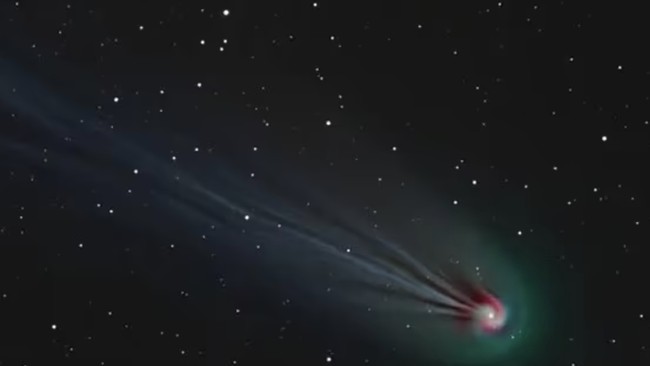
A new study published in the journal Scientific Reports casts doubt on the idea that comets delivered the raw ingredients for life to early Earth, according to CNBC Indonesia. Researchers ran computer simulations of more than 4 billion years ago and found that the heat and pressure of comet impacts would most likely have destroyed the organic molecules the icy bodies carried. The work was led by Richard Anslow, who conducted the research while a doctoral student at the Institute of Astronomy at the University of Cambridge in England.
Why it matters
The finding challenges a theory that has shaped thinking about life's origins for decades. Comets — often described as dirty snowballs because they are made of ice, dust and organic material — have long been viewed as plausible couriers of water and the chemical precursors needed to start biology on Earth. The broader notion that life's ingredients arrived from space is known as panspermia, a concept discussed in scientific circles since 1908, while the specific idea that comets supplied organic material to Earth has been around since at least 1961, CNBC Indonesia reports.
If comets were not the main supplier, researchers say attention should shift to other explanations, including chemical reactions in Earth's own primordial soup or delivery by asteroids.
What the simulations showed
The team used updated models of how comets form and change over time to recreate conditions on the early Earth. They repeated the simulation 100,000 times to test whether a comet could arrive without its organic cargo being ruined.
In 54 percent of runs, no comet struck Earth at all. The remaining 46 percent produced at least one impact, but only a very small share involved as many as three collisions.
Anslow said most strikes left the molecules with no chance of survival. "Based on what we know about surface conditions on the early Earth, on average, our simulations found that no impacts were successful," he said, as quoted by CNN via CNBC Indonesia.
He acknowledged that comets do carry high concentrations of certain molecules important to life. The problem is speed: the typical velocity of a comet hitting Earth is so high that very little, if anything, arrives intact. That makes comets less useful for prebiotic chemistry than previously assumed, he said.
Hydrogen cyanide under pressure
The study focused on hydrogen cyanide (HCN), a compound of hydrogen, carbon and nitrogen that has been detected on dozens of comets, including Halley and Hale-Bopp. HCN is a key precursor in prebiotic chemistry: when it reacts with water, it can produce amino acids, the building blocks of proteins.
On impact, material inside a comet is subjected to extreme temperature and pressure, conditions that can break apart the very organic molecules meant to seed life. Anslow said that even in cases where some HCN survived, the quantity delivered was probably too small to drive the needed chemistry. If a comet landed in the ocean, the HCN would also dissolve quickly, diluting it below useful concentrations.
HCN alone would not be enough in any case. Other compounds containing phosphorus and sulfur are required for prebiotic reactions, and those elements are not routinely found in comets. Delivering one ingredient successfully does not guarantee an environment where life could emerge.
Asteroids, Mars and an open question
With comets looking like weaker candidates, the researchers point to alternatives that deserve more study. One is that early Earth's primordial soup generated the necessary molecules through natural chemical reactions of its own.
Asteroids are another possibility. They generally hit Earth at lower speeds and in greater numbers than comets. Samples returned from the asteroids Bennu and Ryugu support this line of thinking: both contain most of the amino acid types used to build proteins.
The study also raises the prospect that comets played a bigger role on early Mars than on Earth. Because Mars is smaller and farther from the Sun, comet impacts there would have occurred at relatively lower speeds, giving HCN a better chance of surviving. Anslow said this could add a perspective on Mars' early evolution, including whether the red planet once had conditions suitable for life.
The new work does not close the door on comets entirely. Queenie Chan, an associate professor of earth sciences at Royal Holloway University of London who was not involved in the study, suggested HCN may have [the source text ends here].
What to watch: whether follow-up studies test the asteroid route and the primordial-soup scenario with the same rigor, and whether planetary scientists apply the impact-survival model to Mars.